Unsold goods ban, right to repair and PPWR: 3 EU rules in 24 days, and what they change in commercial buildings
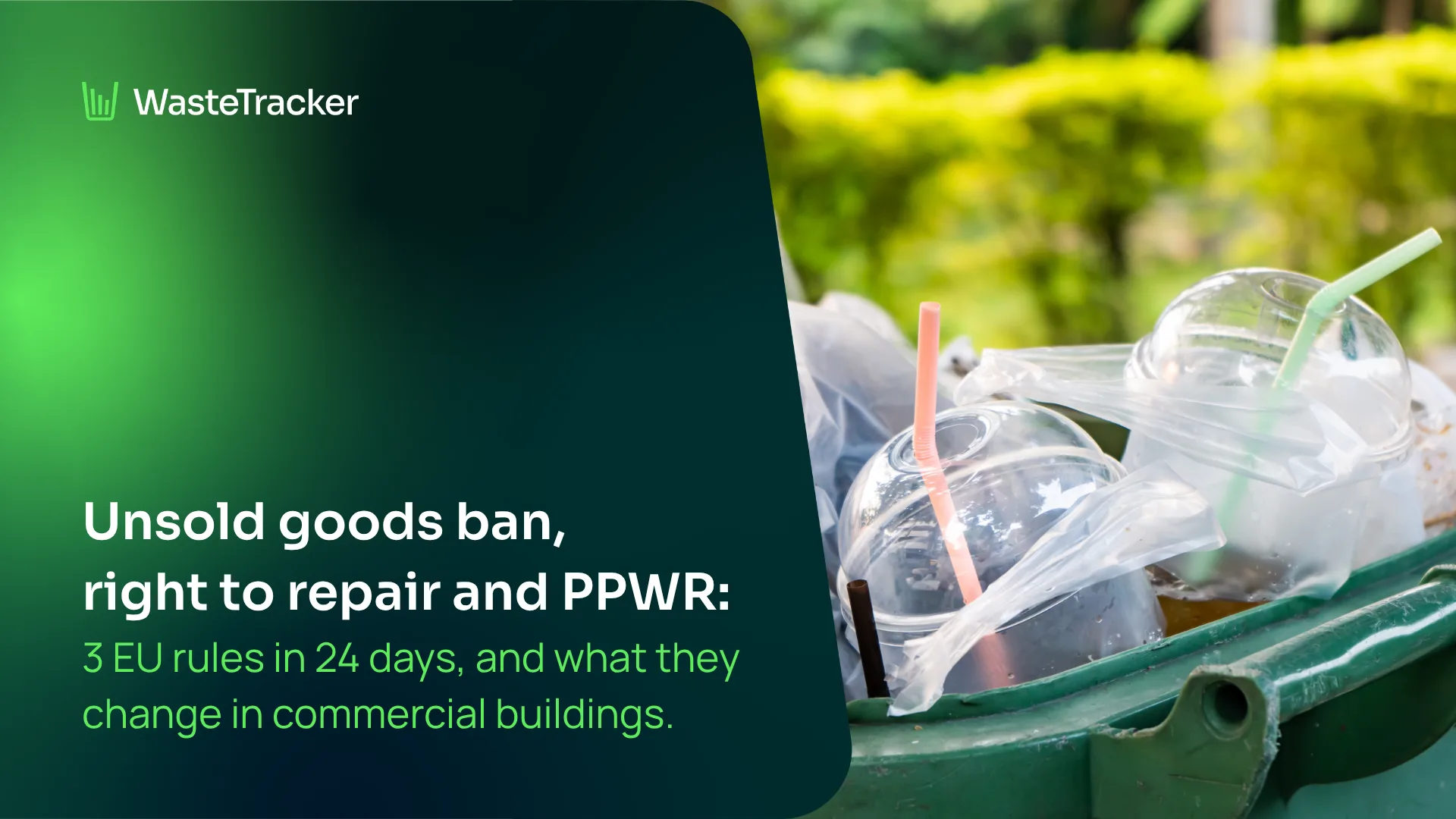
Between 19 July and 12 August 2026, 3 EU circular economy rules started to apply: a ban on destroying unsold clothes, a right to repair and the EU Packaging and Packaging Waste Regulation (PPWR). Here is what each one requires, and where it meets commercial buildings.
Between 19 July and 12 August 2026, 3 pieces of EU circular economy law started to apply. 24 days. A ban on destroying unsold clothes and shoes. A legal right to have a broken fridge, phone or server repaired. And the EU Packaging and Packaging Waste Regulation (PPWR) for all 27 member states.
Each one is addressed to brands, manufacturers or retailers. Their effects arrive in the shopping centre stockroom, the food court and the waste room.
Around them sit 2 more pieces of the same picture. Food waste targets for 2030 are already law, and a Circular Economy Act is expected before the end of the year. We cover both briefly at the end.
Read together, they point in one direction. EU law is moving up the waste hierarchy, from how waste is treated to how much of it is created. For a building, that makes three questions matter more every year: how much waste, of what type, from where.
The unsold goods ban: from 19 July 2026.
Under Article 25 of the Ecodesign for Sustainable Products Regulation, (EU) 2024/1781, large companies can no longer destroy unsold apparel, clothing accessories or footwear. Medium-sized companies follow in 2030, and micro and small companies are exempt. Destruction remains allowed only in listed cases, such as safety risks or damaged goods. Large companies already disclose the number and weight of unsold products they discard, with a standard reporting format from February 2027.
The Commission estimates that 4-9% of unsold textiles in Europe are destroyed before anyone wears them.
In the building: the regulated company is the fashion tenant. Surplus stock that used to leave the dock in a container now moves to resale, donation and reuse.
Right to repair: from 31 July 2026.
The Right to Repair Directive, (EU) 2024/1799, had to be written into national law and applied by 31 July 2026. By 30 July, only a handful of member states had formally notified the European Commission that transposition was complete, so protection will vary by country for a while.
It works on 2 levels. For every consumer product, choosing repair under guarantee extends the guarantee by at least 12 months. For products with EU repairability rules, manufacturers must repair on time and at a reasonable cost, and make spare parts and tools available at a reasonable price. Today that covers washing machines, dishwashers, fridges, displays, servers, phones, tablets and several other appliances. E-bike and e-scooter batteries join on 18 February 2027.
In the building: the direct reach is retail, such as electronics stores, appliance retailers and repair counters. Over time, every repaired display, phone and fridge stays out of the e-waste cage for a few more years.
PPWR: from 12 August 2026, with the big changes in 2030.
The Packaging and Packaging Waste Regulation, (EU) 2025/40, has applied in all 27 member states since 12 August 2026, with no national transposition. The obligations that apply today sit with whoever places packaging on the market: registration, declarations of conformity and limits on hazardous substances.
The rules a building will see arrive on 1 January 2030. That is when recyclability grades, recycled content minimums and reuse targets apply. It is also when restrictions on 6 single-use formats take effect, including plastic cups, trays and condiment sachets for food eaten on the premises, and miniature toiletries in hotels.
The Commission has also missed its 12 August deadline to define harmonised sorting labels. When they arrive, the same pictograms will appear on packaging and on every bin that collects packaging waste, from August 2028 at the earliest. Member states must also cut packaging waste per person by 5% by 2030, compared with 2018.
In the building: the format restrictions land on food court tenants. The labels land on every bin in the waste room and kitchenette, giving a portfolio one sorting language across countries.
Also on the calendar: food waste targets and the Circular Economy Act.
Food and textile waste. The revised Waste Framework Directive, (EU) 2025/1892, entered into force on 16 October 2025. It sets the first binding EU food waste targets for 2030, compared with the 2021-2023 average:
- -10% in food processing and manufacturing
- -30% per person across retail, restaurants, food services and households
The targets bind member states. Each country measures its food waste nationally with a common EU method and answers to the Commission for the result. What individual businesses must do is decided in national law, due by 17 June 2027. Spain shows what that can look like: since 2 April 2026, food businesses there, including restaurants, need a food waste prevention plan, and micro-enterprises are exempt. The same directive requires every member state to run an extended producer responsibility scheme for textiles and footwear by 17 April 2028, paid for by the brands that sell them.
The Circular Economy Act. The Commission planned to propose it in the third quarter of 2026. At the time of writing it has yet to be published. Its aim is a single market for recycled materials and a doubling of the EU's circularity rate by 2030. The value of recycled material depends on how well it is separated at the start, and that happens in the waste room.
One direction, one place to measure it.
3 rules in 24 days, each addressed to someone different: the fashion brand, the manufacturer, the packaging producer. Each moves the decision earlier. Reuse before destruction. Repair before replacement. Prevention before recycling.
Each is also judged in kilograms, and the kilograms appear at the bin. A label tells a tenant which bin to use. Measurement shows whether they used it.
That is the layer waste intelligence adds to a building. The WasteTracker Terminal weighs and registers every disposal by waste type and source, in the waste room, at the moment it happens. TraceBags trace contamination back to the tenant that produced it. The rules have moved upstream. The evidence stays in the waste room.
Sources: Regulation (EU) 2024/1781, Article 25, and Delegated Regulation (EU) 2026/296; European Commission, 9 February 2026; Directive (EU) 2024/1799; Right to Repair Europe, 30 July 2026; Regulation (EU) 2025/40; Directive (EU) 2025/1892; European Commission, food waste reduction targets; Ley 1/2025 (Spain); European Parliament Legislative Train Schedule.